
Explosives and Blasting Services since 1893.
References › Drilling and Blasting
Reunion Island
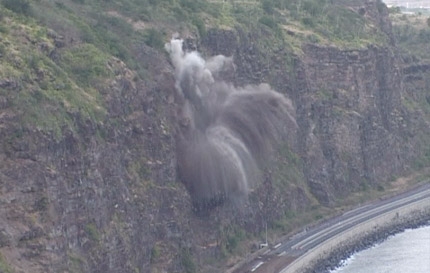
Cliffs of the Coastal Road on Reunion Island: 13 km of rope access work
The “Coastal Road” runs for approximately 13 km below an unstable cliff, prone to landslides and rock falls. This is the busiest road on the Island, with an average vehicle movement of 50,000 per day. EPC Groupe was awarded this project, consisting of the largest roadside cliff stabilisation operation ever undertaken worldwide.
More than 166 protective structures covering an area of 450,000 square metres (the equivalent of 80 football pitches) were completed in 18 months. EPC Groupe had to overcome very specific and relatively new constraints, including rope work being performed on unstable rock faces whilst allowing traffic flow to be maintained on the road below.
To complete this massive project, the Group formed a dedicated, multi disciplined team, made up of people with complementary technical backgrounds, ranging from a geologist to expert rope workers, including a geotechnical engineer, an ecologist, a safety manager and a helicopter pilot.
The project took 18 months and was completed to the full satisfaction of our customer, the DDE (the Reunion Island Departmental Public Works Directorate). Despite all the difficulties involved and the volume being 30% higher than that specified, the contract was completed a month ahead of schedule.
Ax les Thermes bypass
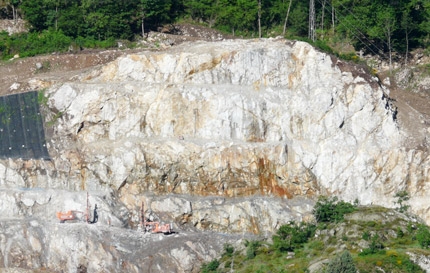
The Ax les Thermes bypass: a complex project on a site surrounded by houses
The work on the RN 20, which initially was undertaken in 2003 by two major French civil engineering companies, was suspended for technical reasons. In 2007, the ROGER MARTIN – SEMEN TP – ALPHAROC consortium took up the challenge of restarting this work with all its technical difficulties. ALPHAROC carried out the drilling, blasting, reinforcement work and excavation with SEMEN TP.
The project consisted of several excavations. The main excavation, located at “En Castel”, overlooks the town of Ax les Thermes. The blasting was carried out within 8 metres of a high-voltage electric pylon. An embankment 56 metres high was created in 12-metres layers.
The excavation located at “Esquiroulet”, was within 15 metres of another high-voltage line pylon, overlooking a holiday camp.
The final excavation at “Cap del Roc” required blasting to be carried out within 15 metres of a house and beneath the cable car line linking Ax les Thermes to the ski resort.
In all, the project involved four rock excavations totalling 450,000 cubic metres and 45,000 metres of rock anchoring. The excavation work represented 850,000 cubic metres of rock which was crushed and used as a fill material in the project.
This 18 millions Euros project took 27 months to complete.
Rheinfelden
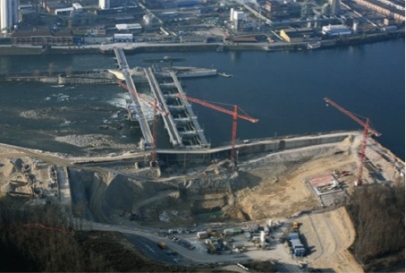
A challenge presented by the Rhine
EPC Groupe played a key role in one of the most arduous and challenging drilling and blasting projects ever undertaken in Germany which involved the excavation of rock from bed of the river Rhine on the German/Swiss border.
The Rheinfelden project was one phase of Germany’s biggest ever hydroelectric programme. A number of turbines were installed in the river bed, the excavation having to attain a depth of 10 to 30 metres. The river was dammed upstream to allow the river bed to be exposed thus allowing the drilling and blasting activities to take place. EPC-Deutschland was required to face numerous challenges, adapting a drilling system to accommodate the use of Multiblend*.
Amongst the challenges to be overcome were maintaining the integrity of the drill holes and to prevent disruption of the explosive column due to the high velocity of the water flow through the rock strata. As a consequence, the emulsion pumping units had to be deployed immediately after the holes had been drilled.
Due to the sensitivity of existing structures on either side of the river, it was necessary to install a number of vibration measuring units in order to monitor blast vibrations and to manage them at specified levels. Initiation timing was optimised to keep vibrations at the lowest possible level.
* a blend of emulsions and ammonium nitrate in appropriate proportions