Explosives and Blasting Services since 1893.
EPC Groupe › interviews
Interview 1/4

Interview with Sébastien Lambert, Director of Alpharoc.
What qualities are required to conduct special drilling and blasting work?
Conducting specialist work requires above all a certain degree of technical expertise, both in quarries and in more complex environments. But human relations also play an important part in our activity because, owing to its specific nature, we very often work with the same people.
What is EPC’s position on this activity?
Our Group now participates in the implementing of large-scale projects in France and abroad, such as motorway and railway construction work.
What are the Group’s main assets in this area?
The variety of additional services we are able to offer for drilling and blasting (nailing, installing of wire mesh, concrete spraying, etc.) gives us our main competitive advantage. Our ability to produce explosives on site is also an undeniable asset. This enabled us, for example, to win a tender in Reunion Island where the importing of explosives is prohibited.
Is there a project to which you have contributed which has made a particular impression on you?
I would say the construction of the Ax les Thermes bypass, for which we mined 450,000 cubic metres of rock to enable excavation and then performed 46,000 metres of cliffside nailing, all of this in an urban environment.
What resources were deployed to conduct this work?
In all, one engineer, one expert site supervisor, two experienced blasters and five drillers were called into action for this work. And we used 5 hydraulic drilling rigs equipped with depth gauges and inclinometers, instruments which are essential for performing such precision work.
What is at stake in your profession today?
As far as our profession is concerned, we wish to demonstrate that explosives are the most effective energy source, and the one with the lowest CO2 emissions, for rock excavation operations.
How do you see your profession changing over the next few years?
I imagine that in the near future, for obvious safety reasons, all drilling and blasting companies will be required to produce on site the explosives necessary for their work. This is something we already do today.
Interview 2/4

Interview with Florent Berthe, EPC-France Blasting Engineer
What does your job as a “blasting engineer” consist of?
Basically, it involves the initiation of explosive place in bore hole drilled for that purpose.
There are two main areas of application: civil engineering and quarry blasting. In both cases, the aim is to obtain optimum rock fragmentation while using the most appropriate quantity of energy.
At EPC-France, the blasting engineer takes part in the transporting, installing and firing of the explosives.
What qualities are required to do this job?
The energy contained in 1 kg of explosives is phenomenal. That is why one of the most important attributes for a blasting engineer is his ability to concentrate on what he is doing. Geological knowledge and experience are the other main qualities required.
Isn’t your job somewhat “out of the ordinary”?
It’s true that with mine closures in France the number of people working in our profession has decreased considerably. There can be no more than 100 of us presently doing this job in France.
What dangers do blasting engineers face?
In our activity there are two major risk types, one is the risk of premature ignition during handling and the second the risk of uncontrolled projection of rock from a blast. The first risk is countered by strictly obeying the instructions for use of the explosives and the second, which is a greater risk, is limited as far as possible by cordoning off a safety zone for each blast.
How do you become a blasting engineer?
There is no set career path, but all blasting engineers hold a Certificat de Préposé au Tir (CPT) [blasting engineer’s certificate], a diploma issued by the French Ministry of Education. This is followed by internal training, which leads to the issuing of a blasting permit which delegates the company’s responsibility to the operator during blasting.
Is there a project to which you have contributed which has made a particular impression on you?
Overall, I’d say the very spectacular sight of building or bridge demolition projects is what has made the biggest impression on me.
Interview 3/4
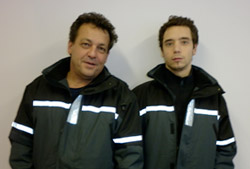
Interview with two production operators (EPC-France)
Can you briefly describe your job?
Our job consists of operating the industrial explosive production lines safely at all times. It involves transforming inert raw materials into an explosive product through a continuous process.
What do you see as being special about this job?
It is not a common job. There are only two production sites in France. Training for this function is done primarily hands-on on site. There is no academic training. The training includes, among other things, developing a sense of responsibility, professional thoroughness and the ability to remain calm.
Is it a widespread profession in France? Or worldwide?
No, because of the specific nature of the product, but the same kind of industrial process control is widespread in the chemical and agro-food industries.
What qualities must a line operator have?
Thoroughness, attentiveness, compliance with procedures, autonomy and quality control.
What dangers do you face? What precautions do you have to take?
We face all the risks associated with the use of chemical products (heat, corrosion, explosion, etc.). It is essential that we wear personal protective equipment: safety glasses, gloves, etc.
What is the standard career path of a line operator?
After safety and quality training, the line operator accompanied by an experienced person starts working in the least technically demanding positions. The most experienced line operators can oversee all the installations.
What does your job contribute to your everyday life?
Our job makes us more vigilant and attentive to everyday safety.
What place does the environment have in your profession?
We are conscious of the importance of the environment as individuals and in our work. We take every step to reduce emission rates. The company aims to obtain ISO 14001 certification by 2012.
What place does safety have in your profession?
Safety is the most important consideration, and we and our outside contractor remain vigilant on site at all times.
Interview 4/4
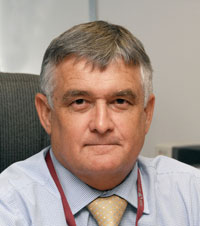
Interview with Ray Keen, Managing Director of EPC UK
Why do we need to produce and sell commercial explosives?
The use of explosives is the most cost-effective and efficient means of crushing rock used in construction. Our products are essential to the everyday life that we all lead, indirectly they are a vital part of the supply chain necessary to construct roads, homes, schools, hospitals and all other public buildings that we take for granted. In addition, without explosives many minerals used in everyday life could not be available, as they are today.
What is EPC Groupe’s strategy?
EPC Groupe has taken the strategic decision to focus its efforts and resources on certain key geographical areas. In addition to our strong base in Europe, where we are one the three largest players, we now have a substantial and growing position in West Africa, which we see as an expanding market. The Middle East is a further target area building from our strong base in the UAE, where we are the leading supplier to their quarrying industry.
What assets would you highlight?
Our Group has over a hundred years experience in the explosives field and with its strong principles and values, brought about by its ownership independence we are able to build a strong loyalty with our employees and customers. The flexibility and relatively quick decision making process, available to us as a result of our ownership structure, means that we can respond more rapidly than most to opportunities and our customer’s needs.
How do you see the future?
We are focused on supplying our customers a value added service where they can share in our extensive bank of knowledge and experience gained over our century in this business. We intend to work even more closely with them to develop new techniques and products to help meet their challenges, particularly in the emerging markets. What we have to offer is unique in a number of ways and we need to ensure we maximise our advantage and be responsive to opportunities wherever they might appear. The future for EPC Groupe is secure.