
Explosives and Blasting Services since 1893.
References › Demolition
Demolition of the GHI tower blocks in Meaux
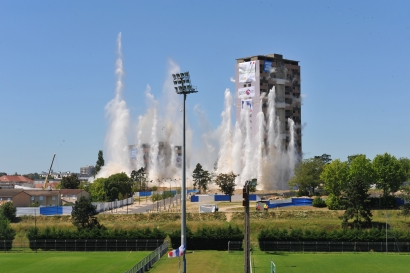
An impressive demolition
As part of the urban renewal program initiated 10 years ago and promoted by the City Council of Meaux, the Genêt, the Hortensia and Iris tower blocks were demolished using the implosion technique on 26 June 2011. This demolition is the last one for the neighbourhood of Meaux' Pierre Collinet, which has gradually, over the years, seen its tower blocks disappear.
The company ATD Démolition, a subsidiary of EPC Groupe, backed by CFD Delair and under the project management of GINGER CEBTP Démolition, was again at the helm. Specialised in this type of work, ATD was already present at the previous demolitions, which were phased over from April 2004 to June 2008.
The deconstruction began with a sorting phase, which lasted 7 months, from September 2010 to April 2011. At the end of this "cleaning" and asbestos removal phase only the concrete structure remained. The materials were then sorted to be recycled (wood, scrap metal) or landfilled (plastic).
The sorting figures are: 196 tons of general industrial waste 182 tons of wood 24 tons of plastic 1,014 tons of plaster
The technique used, implosion, had already been used in this neighbourhood as well as in nearby Beauval. It allows the building to come down in seconds without risk to surrounding buildings. The GHI tower blocks each collapsed in 3 to 4 seconds, with a gap of two seconds between each tower.
The figures of the implosion are: 355 kg of explosives manufactured by EPC FRANCE 710 electronic detonators 1,863 non-electronic detonators
Several measures were taken to ensure the safety as well as the well-being of the local people: the protection of the adjacent buildings within a radius of 50 km, the installation of vibration sensors, to mitigate the effects of the dust, a dual system of 112 water-filled bags placed on the ground and suspended by cables in each block and 24 inflatable water-filled bags at the foot of the towers. These inflatable bags explode thus creating a curtain of water that traps the dust particles. Residents living within a 200-metre radius were evacuated. Around 1,800 people had to temporarily vacate their homes between 9:30 and 18:00.
ATD Démolition's experience allowed a fully controlled demolition to take place in an inhabited area, by implementing all the safety measures which ensured the safety of the residents and their homes.
EDF Cordemais
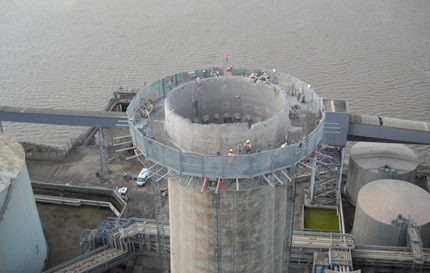
Demolition of an EDF chimney at the Cordemais thermal power plant
As part of the safety work on the Cordemais Thermal Power Plant, EDF placed an order for the demolition of the dust collectors, the chimney and adjacent installations and structures.
The order for the project included overall work plan, asbestos removal, pollution control, dismantling and reconditioning of platforms.
The chimney was located in the immediate vicinity of structures which were required to remain in use to allow the site to function normally during the demolition work.
The project overcame a number of technical challenges. The 150-metres-high chimney was an EDF prototype and was not of standard construction. The internal surface of the chimney body was covered with an asbestos coating which had to be remove prior to demolition, using Ultra High Pressure. A flying scaffold provided access to the work area.
A circular platform was designed to carry out the demolition. It was supported on 6 pegs anchored into the concrete wall of the chimney. The brackets serving as a support for the cylindrical internal duct had to be demolished ahead of the chimney body for safety reasons and to prevent the debris from the chimney body coming into contact with the brackets and therefore potentially weakening the whole structure.
This demolition was a major achievement and an important success for the Group, which demonstrated technical expertise, know-how, ability to control risks and a considerable capacity to adapt to changing circumstances.
Teams from several companies in the Group co-operated to provide their expertise: ATD and Occamat for the demolition, Occamiante for the asbestos removal and 2B Recyclage for the crushing.
The following statistics illustrate the huge scale of the project:
- • chimney demolition: 1 year,
- • 5 people on average present at all times,
- • demolition of internal duct: 4900 hours,
- • removal of asbestos coating: 3200 hours,
- • assembly of external circular platform: 1600 hours,
- • demolition of interior brackets: 1800 hours,
- • demolition of concrete chimney body: 3700 hours,
- • 2 Brokks 50 and 3 Brokks 90,
- • 10 and 40-metre articulated working platforms,
- • 50 and 80-tonne demolition excavators,
- • 4529 tonnes of concrete extracted, crushed and reused as fill material